Home Generator vs. Battery Backup in Portland and Vancouver, WA: What Actually Keeps the Lights On (2026 Costs)
By Power Professor · 22 min read
The January 2024 ice storm ran nine days. Roughly 440,000 PGE customers and 146,000 Pacific Power customers lost power at some point, the average interrupted PGE customer was dark for about 26 hours, and the last neighborhoods in Clackamas and Marion counties waited most of a week. Then the February 2025 windstorm took out 83,000 PGE customers in an afternoon, and the December 17, 2025 windstorm knocked out more than 90,000 Clark Public Utilities customers overnight, the utility's largest event in years. Backup power stopped being a rural concern somewhere around the second of those.
The question we get is almost always the same: generator or battery? The honest answer is that they solve different problems. A generator makes power for as long as you can feed it. A battery stores a fixed amount and is only as good as what refills it. Which one fits your house depends on how long the outages you are planning for really last, what you need to keep running, whether you have natural gas, and how much attention you are willing to give the thing at two in the morning.
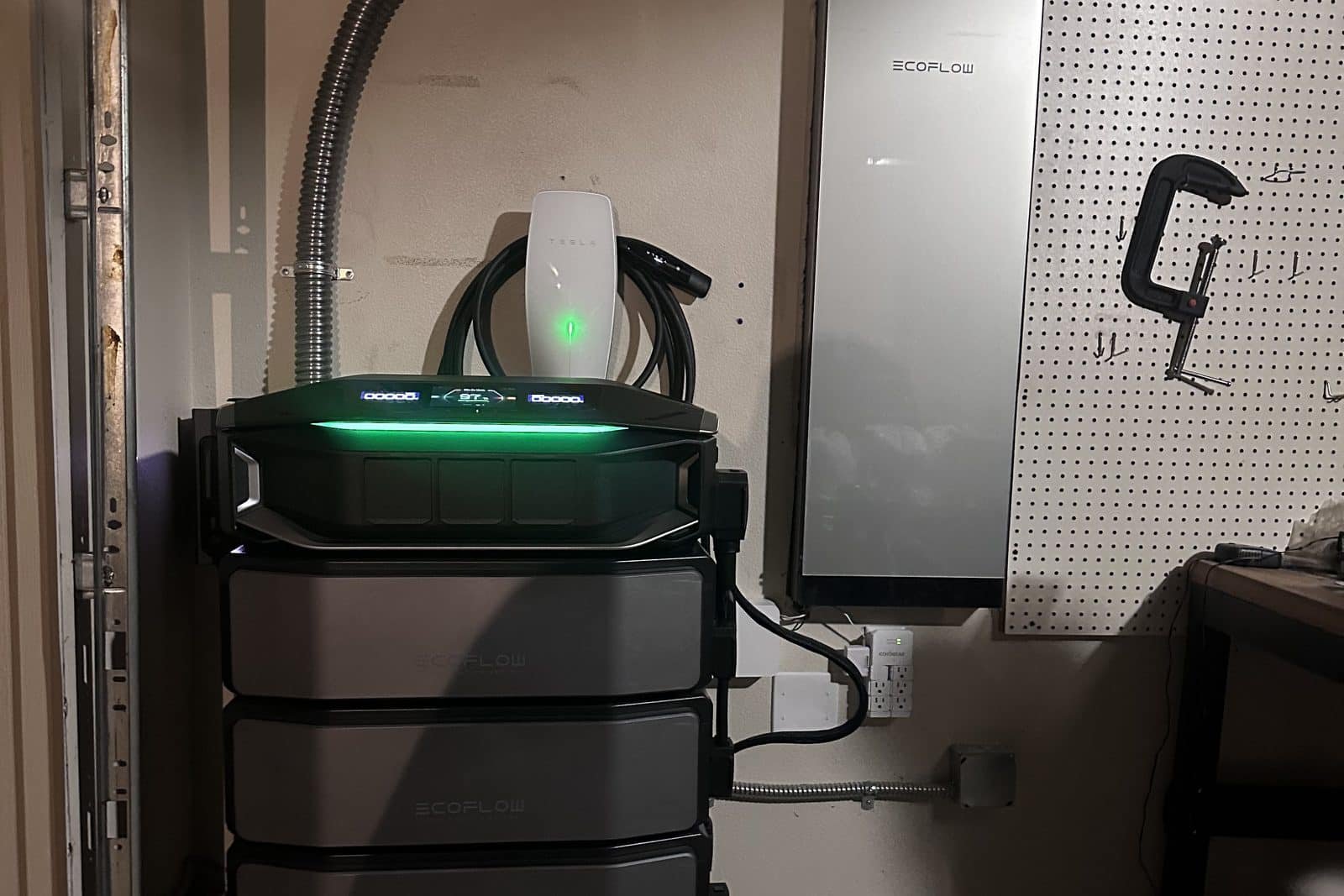
We install both. We put a 22 kW standby generator with a whole-home transfer switch on a house in Gresham last spring and a whole-home battery system with a Tesla charger in a Vancouver garage the winter before. What follows is the comparison we walk customers through, with the outage data, the 2026 prices, the fuel and runtime arithmetic, and the permit rules for each side of the river.
How long the power really goes out in the Portland metro
In an ordinary year the grid here is fine. The average PGE customer lost about 103 minutes to outages in 2025 once major storms are excluded, and Clark Public Utilities, which owns its own poles and buys hydro through Bonneville, typically runs under an hour a year. That is not what you are buying backup power for. You are buying it for the years that are not ordinary, and the last five have supplied plenty.
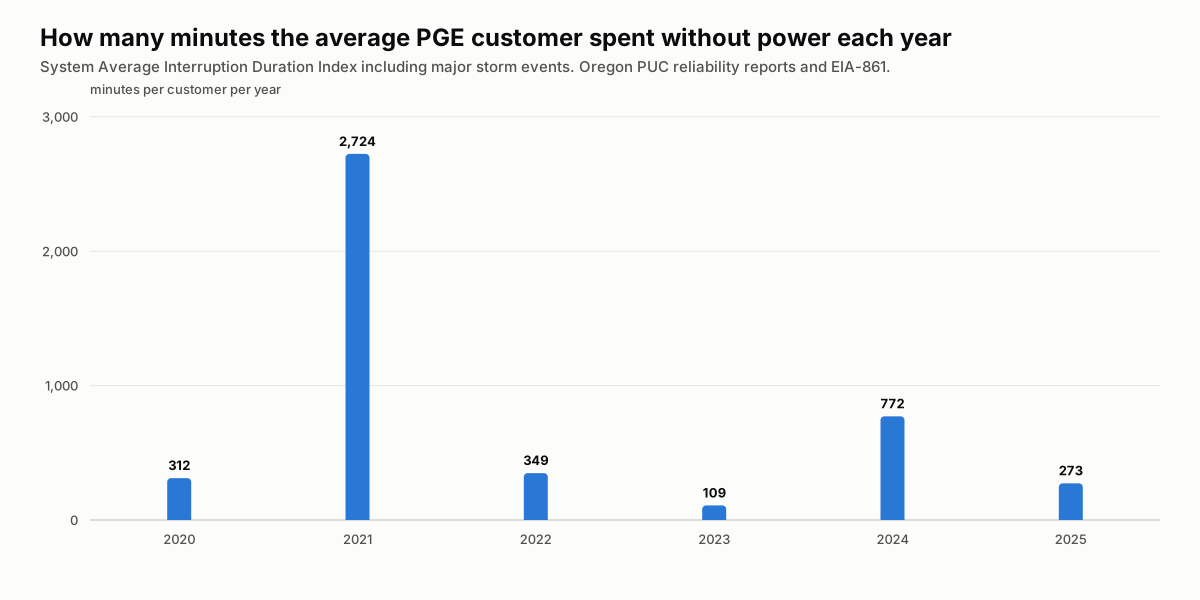
Count the major storms in, and PGE's average customer was without power for 772 minutes in 2024 and more than 45 hours in 2021, the year of the February ice storm. The pattern that matters for sizing a backup system is not the average; it is the tail. Ice storms here produce multi-day outages, because crews cannot work on lines that are still coated, and windstorms produce large but shorter ones. Design for two to four days, not four hours.
The outages homeowners in Portland, Vancouver and Clark County are actually planning for
Event
When
Customers affected
How long it lasted
February ice storm
Feb 2021
PGE's worst year on record: 45 hours per customer averaged across the whole system
Multi-day; many areas 3–7 days
January ice storm (three waves)
Jan 13–22, 2024
≈ 440,000 PGE and ≈ 146,000 Pacific Power customers at some point; Clark PUD peak 24,675
9-day event; 103,000 PGE customers still out on day 6; Pacific Power restoration ≈ 7 days
Windstorm
Feb 24, 2025
83,002 PGE customers; 30,000+ Pacific Power; 8,000+ Clark PUD
Most restored within a day; hardest-hit areas 2 days
Windstorm
Dec 17, 2025
90,000+ Clark PUD customers overnight; PGE's largest 2025 event
Most restored within 24 hours; 27,000 Clark PUD customers still out at noon
Public Safety Power Shutoff (wildfire prevention)
Sept 2020, Sept 2022
≈ 5,000 (Mt. Hood corridor); ≈ 37,000 incl. Portland's West Hills, Oregon City, Estacada
2020: about 5 days; 2022: 1–2 days; PGE says a PSPS can run "several hours to several days"
Average outage time per PGE customer per year, storms included. 2021 was the February ice storm; 2024 the January ice storm. Source: Oregon PUC reliability reports (May 2025, April 2026) and EIA-861.
Two things in that table deserve a second look. First, the West Hills, Tualatin Mountains and Forest Park edge of Portland are inside PGE's named shutoff zones, so a house there can lose power on a clear, dry September day with a few hours' notice. Second, the ice-storm outages were long enough that a battery sized for "overnight" was empty by breakfast on day two. Keep both in mind as you read the runtime numbers below.
Your three real options, side by side
Everything on the market is a version of one of these three: a portable generator you connect to the house safely through an interlock kit or manual transfer switch, a permanently installed standby generator with an automatic transfer switch, or a home battery, with or without solar to refill it. Here is the whole comparison in one table, and the rest of the article is the detail behind each row.
Backup power options for a Portland-area home, 2026
Portable generator + interlock or manual transfer switch
Standby generator + automatic transfer switch
Home battery (13.5 kWh class)
Installed cost
$400–1,600 for the interlock or switch, plus $1,000–5,000 for the generator
$8,500–9,500 (14 kW) to $11,500–13,000 (22 kW), gas line, pad and permits included
$12,000–16,500 for one unit; $19,000–22,500 with an expansion
Runtime
As long as you have gasoline: 15–20 gallons a day at half load
As long as the gas main or propane tank holds out
≈ 29 hours on essentials, ≈ 11 hours at normal whole-house use, without solar
What it can run
Selected circuits you pick at the panel; usually no heat pump or electric range
Whole house on 22 kW+, including a heat pump and well pump
Essentials plus one or two big loads; a Powerwall 3 starts a 185 A motor
Starts itself?
No. You wheel it out, fuel it, start it, throw the switch
Yes, within about 10 seconds, whether you are home or not
Yes, instantly; most people don't notice the switch
Energy Trust up to $5,000 with solar (PGE); utility battery programs; federal credit ended
Best for
Tight budgets, occasional outages, people who are home and handy
Multi-day ice storms, well pumps, heat pumps, anyone who travels
Short outages, solar owners, PGE customers, anyone who can't have a gas engine on site
Option 1: A portable generator with an interlock kit or manual transfer switch
This is the least expensive way to power a house safely, and the word that matters is safely. The generator itself is the easy part: a 7,500–9,500-watt open-frame unit runs $1,000–2,500, and a quiet inverter model like Honda's EU7000iS runs about $4,900. What makes it a home backup system rather than an extension-cord exercise is a permanent inlet on the outside of the house wired to your panel through a listed interlock kit or a manual transfer switch, so that the utility and the generator can never be connected at the same time.
An interlock kit is a metal plate on the panel cover that physically prevents the main breaker and the generator breaker from both being on; installed by an electrician it runs about $400–850. A manual transfer switch is a separate box that moves a handful of chosen circuits between utility and generator, typically $400–1,600 installed. Either way, when the power goes out you wheel the generator out, plug in the cord, throw the switch, and pick what runs.
The limitation is fuel and attention. At half load a 9 kW portable burns about 0.8 gallons of gasoline an hour, which is 15–20 gallons a day and 45–60 gallons for a three-day outage. That is nine to twelve five-gallon cans, stored somewhere, stabilized, and rotated, and someone has to be awake to refill the tank every eight hours. It also cannot run a heat pump or an electric range, so on a January night you are heating with the gas furnace's blower, or not at all.
If this is the route you take, spend the extra money on a carbon-monoxide-shutoff generator and put it at least 20 feet from the house with the exhaust pointed away, never in a garage or under a window. Portland-area emergency rooms see CO poisonings every ice storm, and every one of them is a generator that was "just running for a few minutes" inside.
Option 2: A standby generator with an automatic transfer switch
A standby generator is a permanently installed engine on a pad outside, fueled by your natural-gas line or a propane tank, wired to the house through an automatic transfer switch. When the utility drops, the switch senses it, the engine starts, and about ten seconds later the house is back on. When the utility returns, it hands back and shuts down. You can be asleep or in Palm Springs; it does not matter.
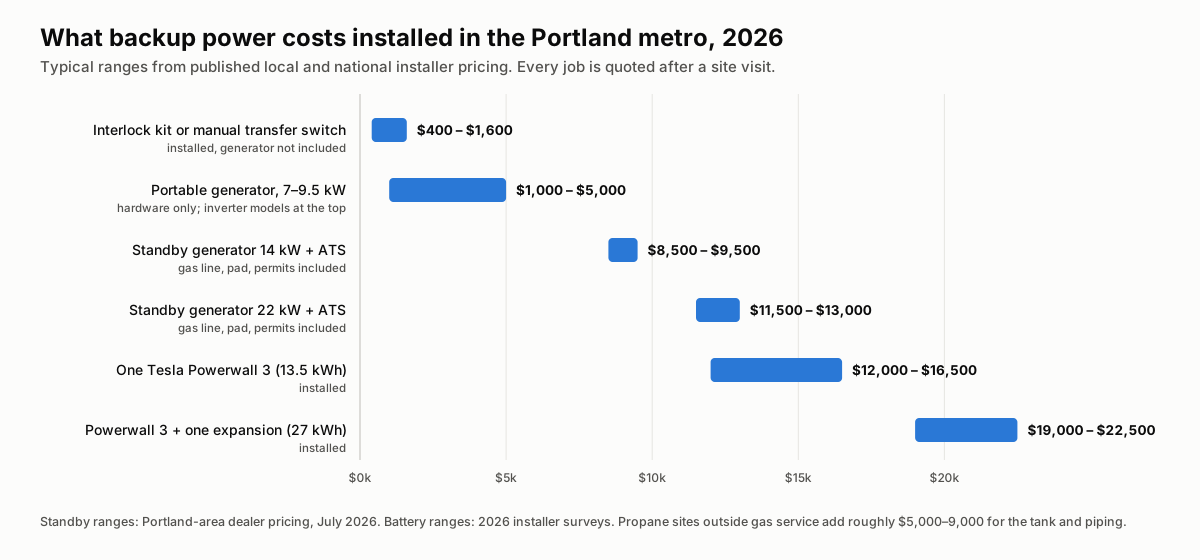
Portland-area installed pricing in 2026 runs $8,500–9,500 for a 14 kW unit and $11,500–13,000 for a 22–24 kW unit, including the transfer switch, the gas connection, the pad, the electrical, and the permits. A 28 kW liquid-cooled unit for a large all-electric home runs $14,500–16,500, and a propane installation outside natural-gas service, tank included, runs $18,000–22,000. The generator itself is only about half of that; the rest is what turns a box into a working system. A quote much under $8,000 almost always leaves out the gas line, the pad or the permits, and you will pay for them anyway.
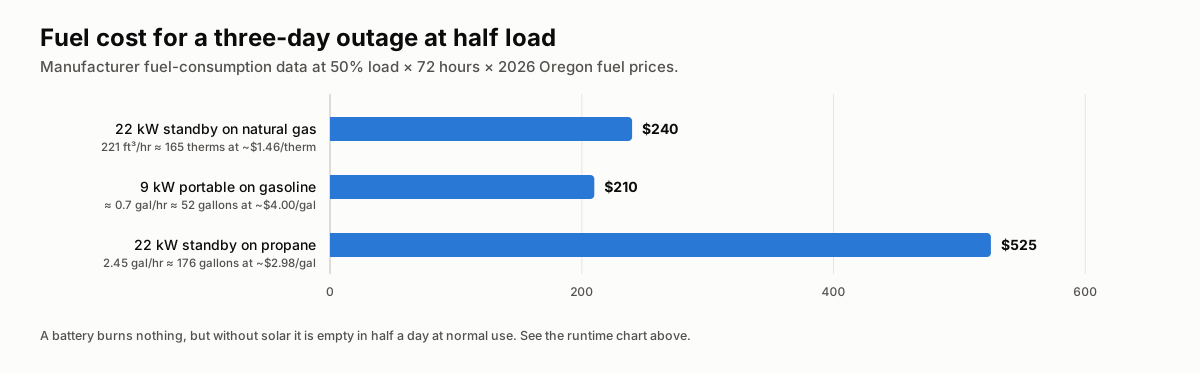
What a 22 kW air-cooled standby generator burns and costs to run (Generac spec sheet, August 2026)
≈ 176 gallons ≈ $525, more than a 250-gallon tank at 80% fill holds
Noise at 23 feet
67 dB(A) running; 55 dB(A) in low-speed weekly exercise
Same
Service
Oil and filter every 200 hours or 2 years; plugs and air filter every 400 hours or 4 years; $450–550 a year from a dealer
Same
Installed price ranges from published Portland-area and national installer pricing, mid-2026. The 22 kW standby and a single Powerwall 3 land in the same bracket; what separates them is runtime.
Two Oregon-specific notes on fuel. Natural gas held up through the January 2024 storm, but not unconditionally: NW Natural hit record demand, a storage facility near Centralia went offline for several hours, and the company asked customers to cut back before it recovered. Gas is far more reliable than the electric grid in an ice storm, and it is still worth remembering that it is a system too. And propane customers should size the tank for the outage they are planning for; a three-day run at half load drinks most of a 250-gallon tank, and the delivery truck is not coming down an iced-over road.
On the house side, a 22 kW unit runs everything in a typical gas-heated home, including the well pump and a heat pump, which is what we installed on the Gresham job. NW Natural's meter usually needs an upgrade to feed a generator ($200 flat if the service line is adequate, $1,500–3,000 if it is not), Portland's plan review takes two to four weeks, and PGE schedules the meter pull for the transfer-switch connection about 30 days out, so a realistic timeline from contract to commissioning is six to ten weeks. Start in September if you want it running by the first ice.
What a whole-home generator install looks like: Gresham, Oregon
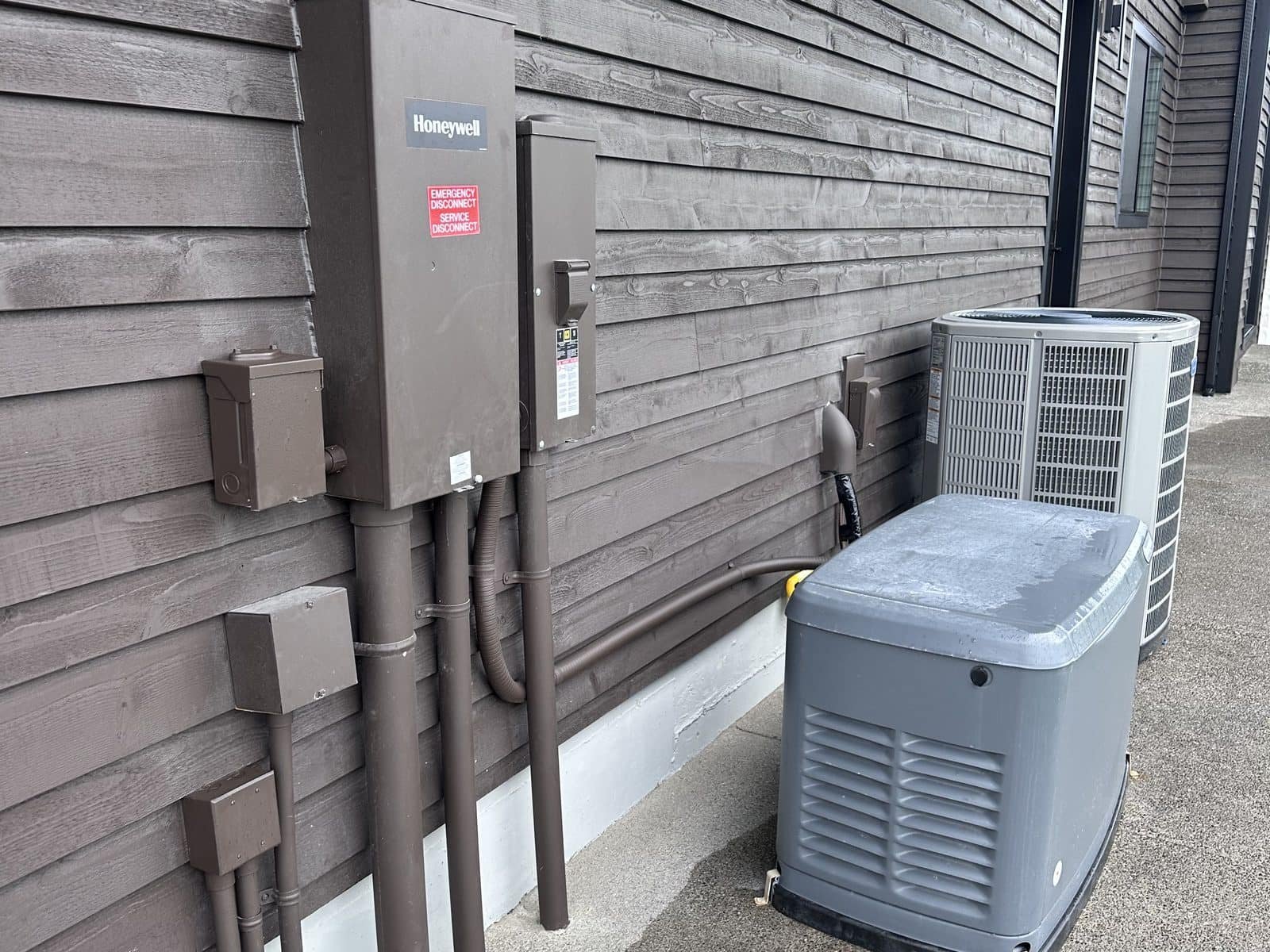
The house in Gresham had a heat pump, a well, and a long driveway, which is the combination that turns a power outage into a no-water, no-heat problem within hours. We installed a 22 kW Honeywell air-cooled standby generator with a service-entrance-rated automatic transfer switch that doubles as the required emergency disconnect, ran the generator's power and control wiring in liquid-tight flexible conduit, added the dedicated battery-charger circuit the unit needs, and pushed an underground feeder out to the well pump house with its own subpanel. The conduits and boxes were painted to match the cedar siding, because nobody wants a generator to be the first thing they see from the driveway.
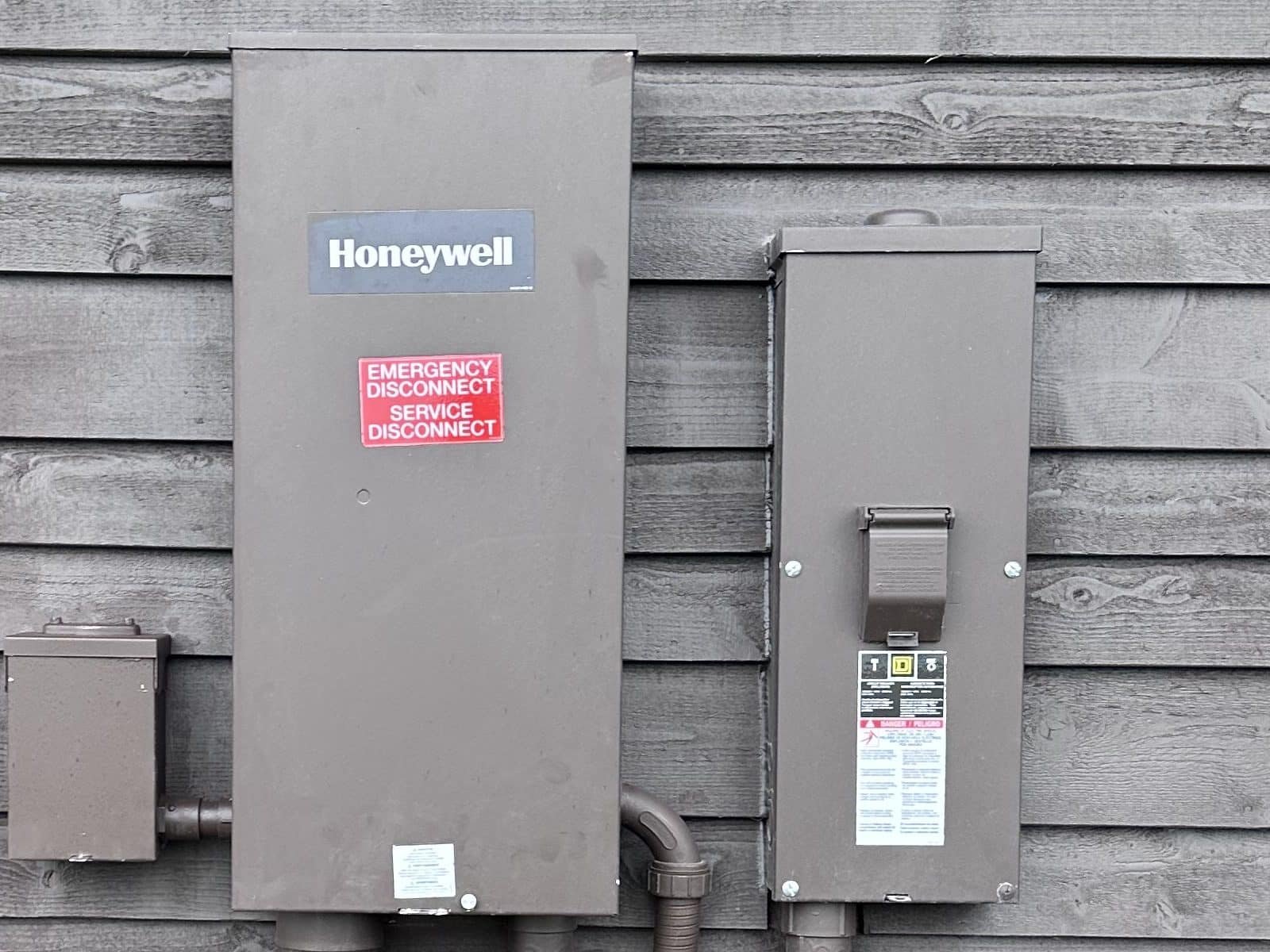
The service-entrance-rated transfer switch on the Gresham job. It is the main disconnect for the house and the transfer point for the generator in one enclosure, which is why it carries the emergency-disconnect label.
That transfer switch is the single most important decision in the whole system. A service-entrance-rated switch sits ahead of the panel and backs up the entire house; a cheaper 100-amp non-service-rated switch backs up a subpanel of chosen circuits. Local pricing for the switch alone runs from about $500 to over $3,000 depending on amperage and rating, and it is the part most likely to be undersized on a low bid.
Option 3: A home battery, with or without solar
A home battery is a wall-mounted lithium-iron-phosphate pack of roughly 10–15 kWh with an inverter that can carry the house, wired in through a backup gateway or a smart panel so that when the grid drops, the house islands itself onto the battery in a fraction of a second. No engine, no fuel, no noise, no exhaust, no maintenance, and it works every day of the year, not just in outages: with time-of-use rates or a solar array it shifts your own power around.
The 2026 price for one Tesla Powerwall 3 installed in the Portland metro is about $12,000–16,500, which buys 13.5 kWh of storage and 11.5 kW of continuous output with enough surge to start a well pump. Enphase's IQ Battery 10C (10 kWh) runs $12,000–14,500, FranklinWH's aPower 2 (15 kWh) $16,500–18,000, and EcoFlow's whole-home OCEAN system, the platform we installed in Vancouver, starts at 10 kWh and expands to 80. A Powerwall expansion unit adds 13.5 kWh for about $5,900 in hardware, and a two-unit system lands at $19,000–22,500 installed.
How long one 13.5 kWh battery lasts, and why the answer depends on what you leave on
What is running
Draw
Energy per day
Hours from 13.5 kWh (no solar)
Refrigerator
≈ 170 W average (1,200 W to start)
≈ 1.4 kWh
—
Gas furnace blower, ½ hp, 8 hours
875 W (2,350 W to start)
≈ 7 kWh
—
Lights, router, phones, TV
≈ 60–150 W
≈ 1.5 kWh
—
Well pump, ½ hp, typical use
1,000 W (2,100 W to start)
≈ 1 kWh
—
Essentials, all of the above
≈ 11 kWh
≈ 29 hours
Essentials plus a 4 kW electric water heater, 2 hours
4,000 W
≈ 19 kWh
≈ 17 hours
Average Oregon home, everything on (EIA 2024)
≈ 29 kWh
≈ 11 hours
3-ton heat pump alone on a 35°F night
≈ 2.6 kW running
≈ 31 kWh
≈ 10 hours
The whole-home battery and Tesla charger we installed in a Vancouver garage. The smart panel decides which circuits stay on when the grid drops; the battery carries them.
That is the honest limit of a battery in an ice storm. One unit keeps the fridge, the furnace fan, the lights and the well pump going for a day and a bit. It does not carry a heat pump through a cold night, and an electric water heater eats most of it in two hours. A second unit doubles everything; solar refills it, but a 7 kW array only makes about 8 kWh on an average January day in Portland, enough to stretch the essentials, not to run the heat. The way to make a battery work for multi-day outages is to wire it through a smart panel or backup subpanel that sheds the heat pump, the range and the water heater automatically, which is exactly what the smart panel in the Vancouver install does.
Batteries have one more thing generators do not: incentives, though fewer than last year. The federal 30% credit ended for batteries installed after December 31, 2025, and Oregon's Solar + Storage Rebate is closed for lack of funds. What remains: Energy Trust of Oregon pays $400 per kWh up to $5,000 for a battery installed with a qualifying solar system in PGE territory ($288 per kWh up to $3,600 with Pacific Power); PGE's Smart Battery Pilot pays $1.70 for every kWh your battery sends back during 10–15 grid events a year; and Pacific Power's Wattsmart Battery program pays $600 per kW up front, capped at $3,000, in both Oregon and Washington. Clark Public Utilities has no battery incentive, and whether Washington's solar sales-tax exemption covers a battery depends on how it is charged; get the installer's written position. We cover the solar side of all this in Is solar still worth it in Portland and Vancouver in 2026?
The three-day ice storm, option by option
Put the three options through the outage we are actually planning for: three days, January, 30°F, gas furnace, well pump, a refrigerator and a freezer, and a family that would like to be warm.
Three days without utility power, January, gas-heated home with a well
Portable 9 kW + interlock
22 kW standby on natural gas
One 13.5 kWh battery (no solar)
Two batteries + smart panel
Heat (gas furnace blower)
Yes, while it's running
Yes, continuously
Yes, about 29 hours
Yes, about 2½ days with loads shed
Well pump / water
Yes
Yes
Yes, until the battery is empty
Yes
Refrigerator and freezer
Yes
Yes
Yes
Yes
Heat pump or electric heat
No
Yes
No, hours only
Limited; shed by the smart panel
Electric range, water heater, dryer
No
Yes
No
No
Someone has to be home
Yes, to start and refuel every 8 hours
No
No
No
Fuel or energy cost
≈ $200 (50 gallons of gasoline)
≈ $240 (165 therms)
$0
$0
Night 2 at 2 a.m.
Refueling in the dark
Asleep
Cold and dark
Asleep, if you shed the big loads
Fuel for 72 hours at 50% load using manufacturer consumption data and 2026 Oregon prices. The gasoline figure assumes about $4 a gallon and does not count the trips to buy it.
Permits, code and utility rules: Portland vs. Vancouver and Clark County
Every one of these systems is permitted work, and the rules are the same on both sides of the river even though the offices are different. The National Electrical Code (Article 702 for optional standby systems) requires listed transfer equipment that makes it impossible to connect the generator and the utility at the same time, a disconnecting means for the generator, and a placard at the service telling the next electrician there is a second source of power. NFPA 37 and the manufacturers set the clearances: Generac requires 18 inches from the back of the unit to the house, 5 feet from any window, door or vent, and 5 feet of clearance overhead. Batteries fall under NEC Article 706 and UL 9540, which is why they are installed in garages and on exterior walls rather than in living space.
Who permits what, 2026 fee schedules
City of Portland
City of Vancouver, WA
Unincorporated Clark County
Electrical permit (transfer switch, generator, or battery)
Portland Permitting & Development: $239 for a 200 A service/feeder line, plus 12% state surcharge; plan review adds 25% when required
City of Vancouver electrical permit (the city runs its own program)
Washington L&I: $109.90 for a transfer switch or altered service (July 2026 schedule)
Setbacks and screening under Title 33; site plan required
Setbacks per city code
Setbacks per county code
Noise
Title 18: 55 dBA daytime / 50 dBA night at the property line; emergency use is exempt, the weekly exercise cycle is not
City noise code
County noise code
Utility, generator
PGE: transfer switch requires a permit and inspection; PGE pulls the meter for a service-entrance switch, scheduled ≈ 30 days out
Clark PUD: transfer switch required, electrical permit required, Certificate of Completion after inspection
Same as Vancouver
Utility, battery
PGE: free interconnection application through PowerClerk for systems up to 25 kW
Clark PUD: $100 application, lockable visible-break AC disconnect, inspection before operation
Same
The noise rule catches people. A standby generator at 67 dB(A) at 23 feet is louder than Portland's 55/50 dBA residential limit at a close property line, but the ordinance exempts emergency use, so running it in an outage is fine. The weekly self-test is not an emergency. Set the exercise cycle for a weekday afternoon, and if the unit is within a few feet of the neighbor's bedroom window, talk to them before you install it, not after.
How to choose: our take
You have natural gas, a heat pump or a well, and you want to stop thinking about it. Standby generator, 22 kW or larger on the NG rating, service-entrance-rated transfer switch. Budget $11,500–13,000 in the metro and start the permit in early fall.
You are a PGE customer with solar, or planning it, and your outages have been hours rather than days. A battery, wired through a smart panel or backup subpanel that sheds the big loads. Energy Trust's $5,000 and PGE's Smart Battery Pilot change the math in your favor, and it works for you every day, not just in storms.
You are on propane, or no gas at all, and outages here run days. It is a real trade. A propane standby costs more to install and to run; a battery runs out. Many rural customers end up with a battery for the short outages and a portable with an interlock for the long ones, which is cheaper than either full system.
Your budget is under $3,000. A portable generator, a CO-shutoff model, and a listed interlock kit installed by an electrician. It is not automatic and it is not quiet, but it is safe, legal, and it keeps the furnace running. Store the fuel properly.
You are in a PSPS zone in the West Hills or the Mt. Hood corridor. Plan for multi-day, dry-weather outages with notice. A generator handles them best; a battery with solar handles them well because September sun refills it.
You are in Clark County. Skip the battery-for-savings math; at 8.79 cents per kWh it does not work. Buy the battery for resilience, or buy the generator, and know that Clark PUD's own reliability is the best in the region in an ordinary year.
Whatever you choose, get the transfer equipment right and get it permitted. That is the part that protects the lineworker, the part the insurance adjuster asks about, and the part the next buyer's inspector looks for.
Where Power Professor fits
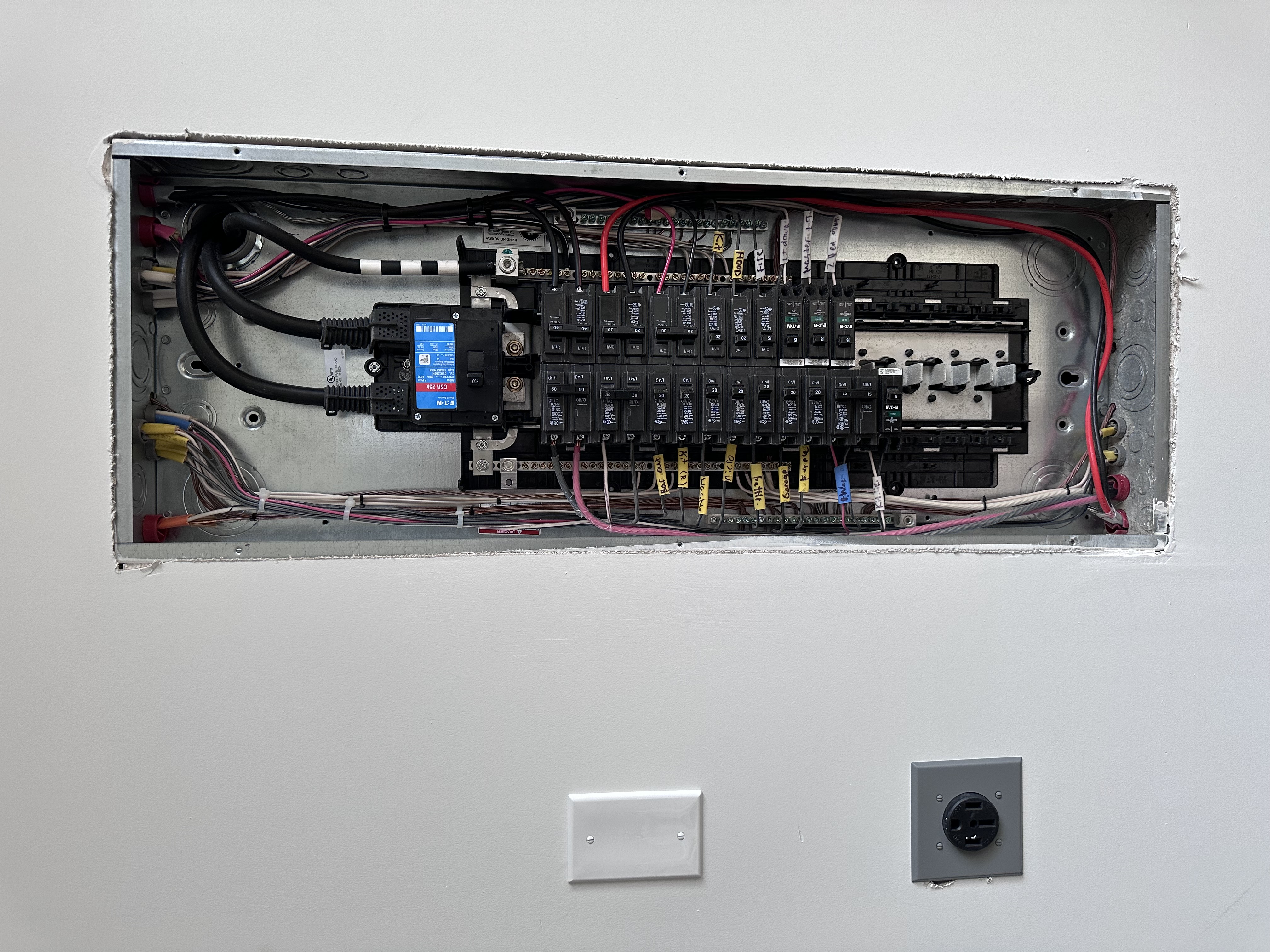
We install interlock kits, manual and automatic transfer switches, standby generators, whole-home batteries and the smart panels that make them useful, in Portland, Gresham, Vancouver, Camas and the rest of the metro. On a generator job we handle the electrical, the transfer switch, the permit and the inspection, and coordinate the gas connection with a licensed gas contractor and NW Natural. On a battery job we handle the whole thing, including the utility interconnection paperwork. If your panel is the older 100-amp kind or a Federal Pacific, that comes first, and we publish real numbers for it in the panel upgrade cost guide.
If you want to know what fits your house, send us a photo of your panel and your meter and tell us what has to stay on. You will get a written estimate with the transfer equipment, the permit, and the utility steps spelled out, and a straight answer about whether a battery or a generator is the right tool for the outages you are actually likely to see.
Answers
Frequently asked questions
01How much does a whole-house generator cost installed in Portland, Oregon?
Portland-area installers in 2026 quote about $8,500–9,500 for a 14 kW air-cooled standby generator and $11,500–13,000 for a 22–24 kW unit, including the automatic transfer switch, the gas connection, the concrete pad, the electrical work and permits. Larger 28 kW units run $14,500–16,500, and propane installations with a tank run $18,000–22,000. Quotes far below these ranges usually leave out the gas line, pad or permits.
02Is a battery or a generator better for Portland ice storms?
For multi-day ice storms like January 2024 and February 2021, a natural-gas standby generator is the more reliable choice because it runs as long as the gas main does. One 13.5 kWh battery runs essentials for about 29 hours and a heat pump for only about 10, though solar can extend it. Batteries are the better fit for shorter outages, PGE customers with solar and Energy Trust incentives, and homes that cannot have a gas engine on site.
03Can I plug a generator into my dryer outlet to power my house?
No. Back-feeding through a dryer or range outlet is a code violation in Oregon and Washington, can energize the utility line and electrocute a lineworker, and voids insurance. Both states require listed transfer equipment (an interlock kit or transfer switch) installed under a permit by a licensed electrician, and the interlock must be the kit listed for your exact panel.
04How long will a Tesla Powerwall 3 run my house?
A Powerwall 3 stores 13.5 kWh. Running only essentials (refrigerator, gas furnace blower, lights, router, a well pump) uses about 11 kWh a day, so roughly 29 hours. The average Oregon home uses about 29 kWh a day with everything on, which empties it in about 11 hours, and a 3-ton heat pump on a 35°F night uses about 31 kWh a day. A second unit or solar recharge extends it; a smart panel that sheds big loads is what makes it last.
05Do I need a permit for a standby generator in Portland or Vancouver?
Yes. In Portland you need an electrical permit for the transfer switch and generator wiring (the 200 A service/feeder line is $239 plus a 12% state surcharge on the July 2026 schedule) and a mechanical permit for the gas appliance and fuel piping ($51 each, $167 minimum), plus a site plan meeting Title 33 setbacks. In Vancouver and Clark County the electrical permit comes from the City of Vancouver or Washington L&I ($109.90 for a transfer switch), plus a mechanical/gas permit, and Clark PUD requires a Certificate of Completion after inspection.
06Does natural gas stay on during a power outage?
Almost always. Gas mains are underground and do not depend on the electric grid, which is why natural-gas standby generators are the standard for multi-day outages. It is not unconditional: during the January 2024 ice storm NW Natural hit record demand, a storage facility near Centralia went offline for several hours, and the company asked customers to conserve before recovering without major disruption.
07Are there rebates for home batteries in Oregon or Washington in 2026?
The federal 30% credit ended for batteries installed after December 31, 2025, and Oregon's Solar + Storage Rebate is closed for lack of funds. Still available: Energy Trust of Oregon pays $400 per kWh up to $5,000 for a battery installed with qualifying solar in PGE territory ($288/kWh up to $3,600 with Pacific Power); PGE's Smart Battery Pilot pays $1.70 per kWh delivered during grid events; Pacific Power's Wattsmart Battery pays $600 per kW up to $3,000 in both states. Clark Public Utilities offers no battery incentive.
08How loud is a standby generator, and is it allowed under Portland's noise rules?
A 22 kW air-cooled Generac produces about 67 dB(A) at 23 feet while running and about 55 dB(A) during its weekly low-speed exercise; Kohler's comparable unit is 70 and 66. Portland's Title 18 limits residential noise to 55 dBA daytime and 50 dBA at night at the property line, but exempts emergency equipment, so running in an outage is allowed. The weekly self-test is not exempt, so schedule it for a weekday afternoon.
Electrical panel upgrades and replacements for Portland and Vancouver, WA homes — 100A to 200A service upgrades, Federal Pacific and Zinsco swaps, permit and inspection included, priced in writing before we start.
Full-service residential electrical work for Portland and Vancouver homeowners — panel upgrades, rewiring, lighting, and everyday repairs done safely and to code.
Oregon and Washington have different smoke and carbon monoxide alarm rules for owners, sellers, landlords and remodels. Here is what each state requires, where alarms go, when they expire, why hardwired alarms chirp, and what replacement costs.
A 1,500-watt space heater pulls 12.5 amps, which leaves a standard 15-amp bedroom circuit no room for anything else. Here is why the breaker trips, why the trip is not the real danger, and what the fixes cost in Portland and Vancouver.
The 30% federal credit is gone for any system finished after December 31, 2025. That changes the math, but not the same way on both sides of the river. Here is what a Portland (PGE) and a Vancouver (Clark PUD) homeowner actually gets in 2026, how much a roof here really produces, and what your electrical panel needs before a single module goes up.
Get a backup power plan sized for your house, not a brochure.
Send us a photo of your panel and meter and tell us what has to stay on when the grid drops. We'll price the transfer switch, the generator or battery, the permits and the utility steps, and tell you straight which one fits.